
Today is the day.
Today is the day you finally get organised, stop wasting time and start getting everything done.
Today is the day you start making all your dreams come true.
You have spent ages researching diaries and planners. You have compared layouts, read reviews and watched other women calmly turn blank pages into colour-coded works of art.
Eventually, you found it.
The planner.
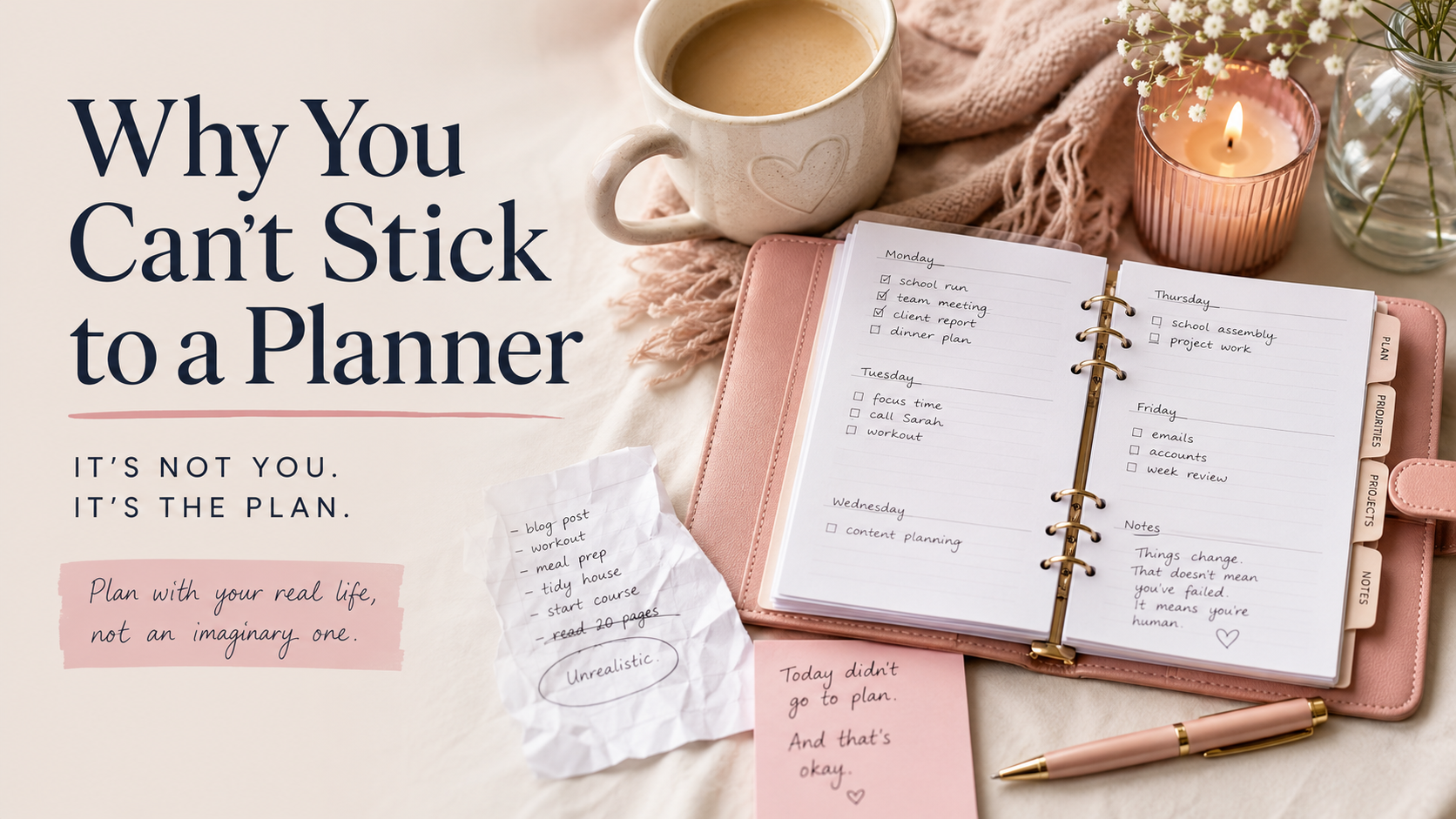
It has a beautiful deep rose leather cover, satisfyingly thick pages and a full year of dated opportunities for achievement.
You waited for it to arrive and, when it did, you spent hours filling it in. You transferred appointments from your phone and work calendar. You mapped out the month. You decided on your priorities for the week.
You used your nicest pen.
For several days, it felt as though your life was finally under control.
Then one of your children was off school sick.
Instead of completing the work you had planned, you spent the day with a snotty four-year-old attached to your hip, demanding snacks and becoming increasingly distressed because you could not find the very specific blue car he wanted to play with.
By the end of the day, you had not done what you planned.
You had not worked out.
You had not even managed a shower.
You were absolutely knackered.
Then the whole week was thrown off because you stayed up far too late trying to get some time to yourself by watching Netflix or scrolling mindlessly through your phone.
The planner was quietly abandoned.
And now, every time you see it, you feel slightly guilty.
Here is the thing.
I do not think the planner is the issue.
I think it is the plan.
We make plans for an imaginary version of life
Most of us create plans for the version of the week where everything goes reasonably well.
Nobody gets ill.
Nobody needs an urgent lift somewhere.
Meetings end when they are supposed to.
Tasks take exactly as long as we estimated.
We sleep properly.
Our energy remains stable.
We do not suddenly lose an hour looking for a school jumper that was apparently “definitely on the chair” but has somehow vanished from the face of the earth.
We plan based on our best-case capacity and then expect our future selves to deliver it, regardless of what actually happens.
This is partly optimism bias. We underestimate the likelihood of disruption and overestimate how much we will be able to achieve.
We assume the week ahead will contain the exact amount of time, energy and motivation needed to complete the plan we have created.
Which is a lovely idea.
It is also rarely true.
Things almost never go completely to plan.
That does not mean planning is pointless. It means that a useful plan needs to be built for real life, rather than for an imaginary week in which everyone behaves, everything works and we feel permanently well rested.
Writing something down can make it feel fixed
There is something about writing a plan neatly into a beautiful planner that makes it feel official.
Once the appointments are entered, the tasks are allocated and the week has been carefully divided into sections, the plan stops feeling like a suggestion.
It starts to feel like a contract.
Monday: complete report.
Tuesday: work out, batch-cook and finally sort the cupboard.
Wednesday: become the sort of woman who remembers to drink water.
Then life changes, but the plan remains sitting there on the page, unchanged and quietly judgemental.
We can become surprisingly rigid about plans once we have written them down.
A task moved to tomorrow feels like procrastination.
A missed workout feels like a failed routine.
A morning lost to something unexpected feels as though the entire day has been wasted.
And once we feel behind, it is easy to give up altogether.
But a plan is not a prediction of exactly what will happen.
It is simply the best decision you could make with the information you had at the time.
When the information changes, the plan should change too.
That is not a lack of discipline.
It is a sensible response to reality.
We measure ourselves against the unfinished list
Planners are very good at recording what we intended to do.
They are often much less effective at recording what we actually did.
The unchecked boxes remain visible. The unfinished tasks are carried into the next day. The original plan sits there as evidence of everything we failed to complete.
What it does not show is that you spent three hours looking after a sick child.
It does not record the work crisis you resolved, the unexpected phone call you dealt with or the meal you somehow produced when everyone was hungry and there appeared to be nothing in the fridge.
It does not capture the emotional load of managing other people’s needs.
It does not acknowledge that you kept the household functioning while tired, distracted and operating on approximately four uninterrupted minutes of thought.
The planner shows the report you did not finish.
It does not show the twenty other things that took its place.
That creates a distorted view of the week.
You compare what actually happened with an ideal plan that was created before reality got involved.
Then you conclude that you are disorganised, inconsistent or simply not very good at sticking to things.
A better review asks two separate questions:
- What did I intend to do?
- What did I actually achieve, manage or respond to?
Both matter.
Looking honestly at what happened is not making excuses. It gives you better information for the next plan.
The lesson we can take from project planning
One thing I have learned from working in project and programme environments is that things never go to plan.
Not occasionally.
Not only when someone has made a mistake.
They just do not.
Plans are created using the best information available at that point. Then risks emerge, priorities change, dependencies slip and something that was supposed to take two weeks takes six.
A good project team does not keep following the original plan purely because somebody once typed it into a spreadsheet.
The plan is reviewed.
Resources are moved.
Priorities are reconsidered.
Activities are delayed, adapted or stopped.
In complex work, changing the plan is not automatically viewed as failure. It is part of managing the work properly.
Yet in our personal lives, we often expect ourselves to follow a weekly plan with more certainty than most large organisations expect from a multi-year programme.
Your life has competing priorities, limited resources, unpredictable demands and changing levels of energy.
In other words, it is a complex delivery environment.
You need to manage it accordingly.
You need to expect the expected
People often say that we should “expect the unexpected”.
I think we also need to get better at expecting the expected.
Children get ill.
Traffic happens.
Work takes longer than planned.
People need help.
Our energy changes.
We sleep badly.
Hormones, stress and emotional demands affect what we are capable of doing.
None of this is particularly surprising.
We might not know exactly what disruption will happen or when, but we know that something usually will.
Yet we often fill every available space in the plan and then act shocked when there is no room to absorb real life.
A realistic plan needs spare capacity.
That might mean leaving some of the week deliberately unallocated.
It might mean choosing fewer essential priorities.
It might mean knowing in advance which tasks can move without causing a disaster.
It might mean resisting the temptation to plan for your most energetic, efficient and wildly optimistic self.
A plan that only works if nothing goes wrong is not a good plan.
It is a fantasy with checkboxes.
Why time blocking does not work for everyone
Time blocking can be genuinely useful.
For some people, assigning a task to a specific period reduces indecision and helps them focus.
But it is not the only legitimate way to organise your life.
A highly detailed schedule can become restrictive when your job is unpredictable, your children frequently change the plan or your energy does not remain constant throughout the day or month.
You may not need to schedule every single hour.
You may not need to build a perfect morning routine.
You may not need to go away to focus or remove every possible distraction.
Realistically, most women cannot remove all distractions because many of those “distractions” are small humans asking where their shoes are.
Often, you need something much simpler:
- Clear priorities.
- A flexible plan.
- Permission to pivot.
The purpose of planning is not to control every minute.
It is to help you direct the time and energy you do have towards the things that matter most.
Plan with both time and energy
Most planners organise work according to time.
What needs to happen on Monday?
What can be completed before lunch?
How many tasks fit into the afternoon?
But time is only one part of the equation.
Two tasks might both take an hour and require completely different amounts of energy.
Replying to routine emails might take an hour but require very little thought.
Making an important decision might take fifteen minutes but use every bit of concentration you have.
Writing an article might be relatively quick on a good day and almost impossible when your brain feels like it has been replaced with porridge.
A more realistic planning approach considers two questions:
- How much time will this take?
- How much energy will this require?
This creates four broad types of work.
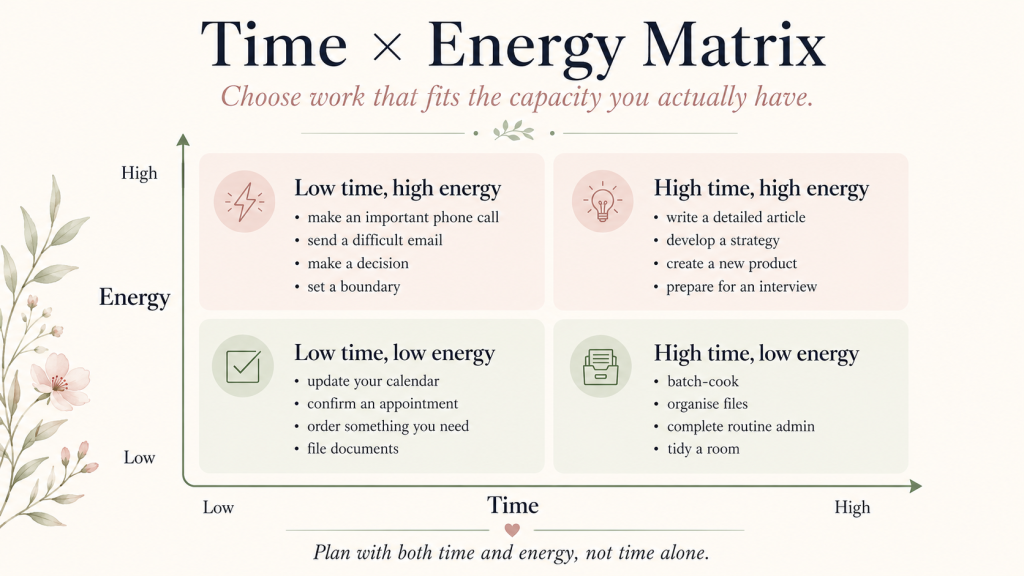
Low time, low energy
These are useful when you have a small pocket of time or very little capacity.
Examples include:
- confirming an appointment
- updating your calendar
- ordering something you need
- saving ideas for later
- completing a short form
- checking a delivery
- filing a document
- updating a tracker
These tasks will not change your life, but they can stop small pieces of admin accumulating into one enormous, irritating pile.
Low time, high energy
These tasks may be brief, but they require focus, confidence or emotional effort.
Examples include:
- making an important phone call
- sending a difficult email
- making a decision
- recording a short video
- setting a boundary
- asking for help
- giving honest feedback
- starting something you have been avoiding
The fact that something only takes ten minutes does not mean it is easy.
Sometimes we delay short tasks because we do not have the right kind of energy for them.
High time, low energy
These tasks take longer, but they can often be done steadily without intense concentration.
Examples include:
- organising files
- batch-cooking
- sorting clothes
- completing routine administration
- entering information into a spreadsheet
- editing straightforward content
- tidying a room
- preparing materials for later
These can be useful when you have time available but are not feeling capable of doing your most demanding work.
High time, high energy
These are the tasks that need genuine capacity.
Examples include:
- writing a detailed article
- developing a strategy
- completing complex analysis
- creating a new product
- preparing for an interview
- resolving a difficult issue
- making a major financial decision
- leading an important workshop
These tasks should not be squeezed into whatever time is left after everything else.
They need protecting.
Thinking about work in this way gives you alternatives.
If your energy changes, you do not need to abandon the whole day. You can choose work that fits the capacity you actually have.
That is very different from forcing yourself through a task simply because Tuesday-you confidently assigned it to Thursday.
Productivity is not just about doing more
Another problem with planners is that we often fill them almost entirely with output.
Finish the report.
Clean the house.
Complete the workout.
Write the post.
Reply to the emails.
Sort your entire life out before 3pm.
But a sustainable life also requires preparation, maintenance, connection, reflection and rest.
Sometimes the most useful thing you can do is not produce another visible result.
It might be:
- preparing food for a busy week
- resting before you become completely exhausted
- spending time with somebody important
- thinking through a decision
- going for a walk without trying to turn it into a fitness target
- addressing a problem you have been avoiding
- making space before starting something new
- learning rather than immediately producing
These things are easy to dismiss because they do not always result in something tangible that can be ticked off.
But they protect your ability to keep going.
A good planning system should support a full life.
It should not turn your entire existence into a production line.
A practical way to plan more flexibly
You do not need to buy another planner to do this.
I appreciate that this may be inconvenient news if you were hoping the answer was a new notebook.
You can use the planner you already own, a basic notebook, a digital document or the notes app on your phone.
The tool matters far less than the thinking behind it.
Start with three steps.
1. Get clear on your real priorities
Choose a small number of outcomes that genuinely matter for the week.
Not everything can be a priority.
If everything is important, you have simply created a long list.
Ask yourself:
- What genuinely needs to happen?
- What would create the most meaningful progress?
- What has a real deadline or dependency?
- What can move without causing serious consequences?
- What have I included mainly because I feel I should?
Try to identify one to three essential priorities.
This does not mean you can only do three things all week. It means you know which things should still matter when life inevitably starts interfering.
2. Build a flexible plan
Instead of assigning every task to a fixed hour, create options.
You might organise your work into:
- essential this week
- useful if capacity allows
- low-energy tasks
- high-energy work
- things that can wait
Appointments and genuine deadlines can still be fixed.
The rest of the plan can remain flexible enough to move.
This gives you room to adapt without treating every change as a crisis.
3. Review and pivot without judgement
Do not create the plan on Sunday and then avoid looking at it again until Friday, when you discover that almost none of it happened.
Check in with it during the week.
Ask:
- What has changed?
- What capacity do I have now?
- What still matters most?
- What can I reduce, move, delegate or drop?
- What have I done that was not in the original plan?
Then update it.
Your plan is allowed to change because your life has changed.
That is the entire point of reviewing it.
Your planner should support your decisions, not judge them
The best planner is not necessarily the most beautiful, detailed or expensive one.
Although a deep rose leather cover is still very nice.
The best planner is the one that helps you decide what matters, understand your capacity and keep moving when circumstances change.
You do not need to follow the same routine every day.
You do not need to operate at your highest level every week.
You do not need to complete everything you once thought would be useful.
And you do not need to feel guilty for changing a plan that no longer reflects reality.
You need enough structure to guide you and enough flexibility to respond when life gets in the way.
The planner was never supposed to be a test of your discipline.
It was supposed to help you navigate.
Ready for a more flexible way to plan?
The Productivity Cycle is designed to help you plan around changing energy, priorities and capacity instead of expecting every day to look the same.
It gives you a practical framework for deciding what matters, choosing work that fits the capacity you have and reviewing your progress without using an unfinished list as evidence that you have failed.
You can explore The Productivity Cycle workbook, or begin with the free starter guide to try the approach first.