
When you decide that something in your life needs to change, what do you usually do next?
For many of us, the answer might be to design a new routine.
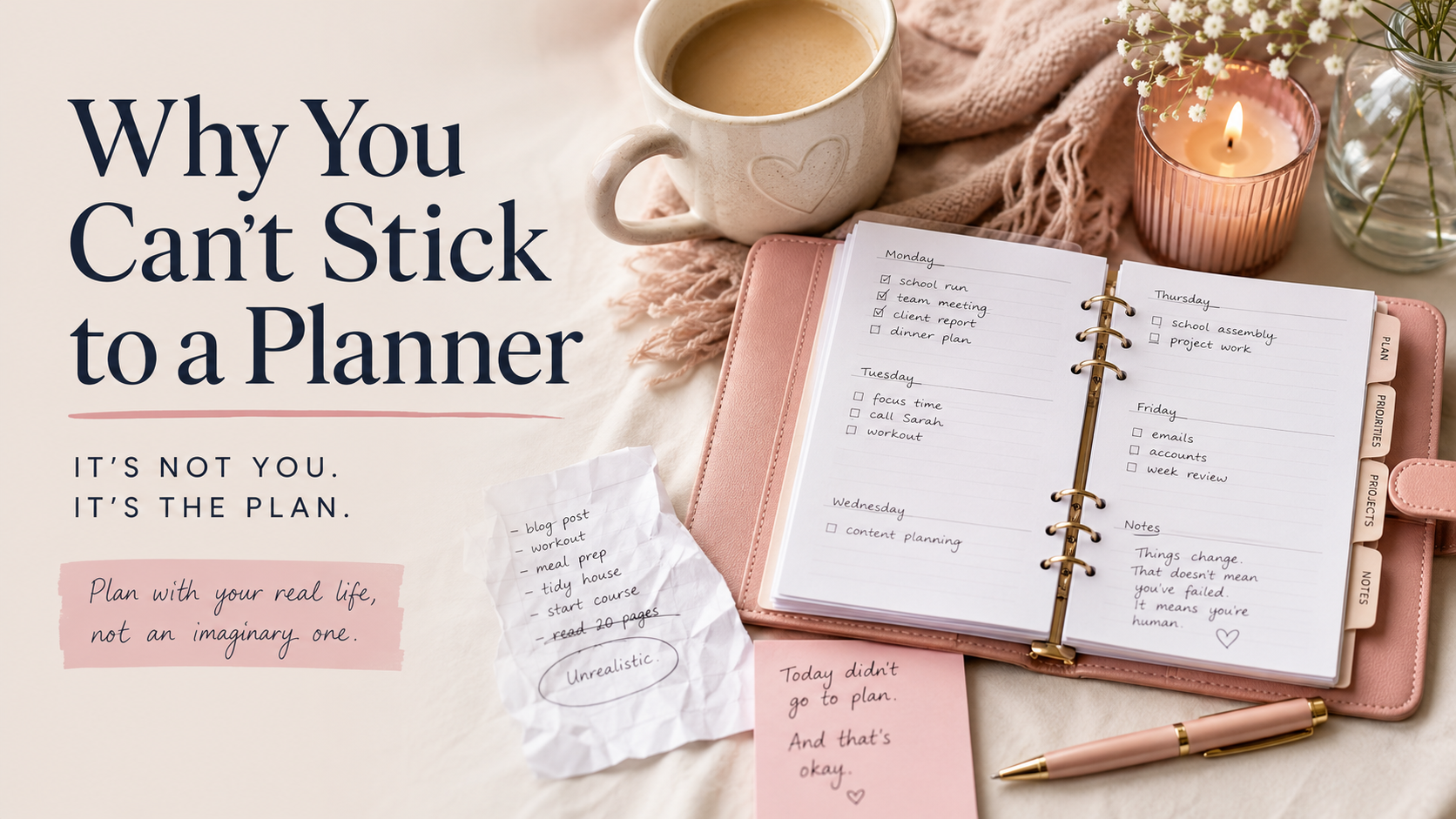
We decide that tomorrow will begin at 5 a.m. There will be exercise, vitamins, journalling, meal preparation, focused work, a spotless kitchen and an early night. The plan often looks excellent on paper.
Then ordinary life resumes.
The trainers have not been worn for a week. The vitamins are gathering dust. The early alarm is waking everyone else up. Within days, the new routine begins to feel like another promise you have failed to keep.
But the problem may not be your discipline.
The problem may be that you tried to use habits to do the work of a project.
What is a habit?
A habit is a small, repeated action or behaviour that becomes easier and more automatic over time.
Habits are particularly useful for maintaining momentum, protecting something that already matters or creating a reliable baseline.
Saving £100 on every payday can steadily build a Christmas fund. Going for a regular run can help maintain cardiovascular fitness. Completing a weekly review can stop important priorities disappearing beneath urgent tasks.
Once established, these behaviours reduce the need to make the same decision repeatedly.
That is what makes habits powerful.
They are less useful, however, when you need to create a significant result quickly or coordinate several different actions at once.
Suppose you needed to generate an additional £10,000 within ten days. Your normal payday saving habit would not be capable of producing that result. You would need to consider a different set of actions, choices, resources and constraints.
That is project territory.
What is a project?
A project is a time-limited effort designed to produce a specific output or outcome.
It has a defined purpose. It usually has an end point. It often requires several connected actions rather than one behaviour repeated forever.
A personal project does not need a complicated plan or specialist software.
It could be:
- preparing for a professional qualification;
- decluttering and reorganising a room;
- launching a small business offer;
- completing a 10-kilometre race;
- building a three-month emergency fund;
- changing a process that is creating repeated stress at home or work.
Each of these goals requires more than repetition. You need to understand the outcome, identify the work, make choices, manage dependencies and concentrate effort for a period of time.
The simplest way to tell the difference
Ask one question:
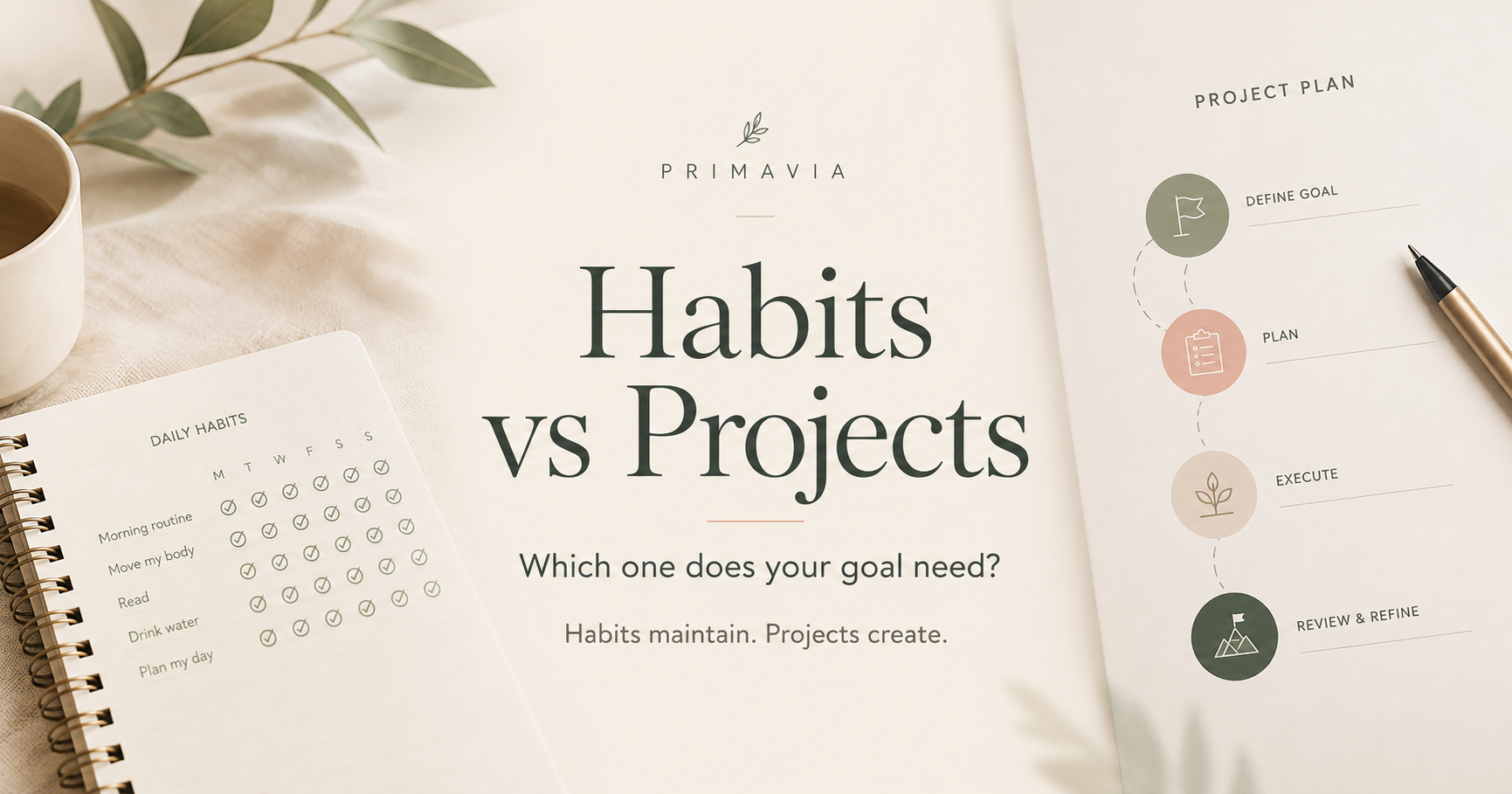
Am I trying to maintain something, or create something?
A habit is usually the better mechanism when you need to maintain a result or repeat a useful behaviour indefinitely.
A project is usually the better mechanism when you need to create a new result, complete something or make a defined change.
There will be overlap.
A project may help you establish a habit. A habit may help you sustain the result of a project. The important thing is to understand which one is doing which job.
Projects can help you build habits
Imagine that you want to start going to the gym regularly. You could simply tell yourself that you will go three times a week. That is the habit you ultimately want.
But several practical barriers may sit between the intention and the behaviour. You may need to choose a gym, find suitable sessions, buy clothing, arrange childcare, decide which days are realistic and work out how the new commitment fits with the rest of your week.
Treating the change as a short project allows you to remove those barriers deliberately.
Your project outcome might be: Create a realistic gym routine that I can sustain for the next three months.
The project ends when the routine, environment and support are in place. The habit then continues.
Habits can maintain the results of projects
The relationship also works in the other direction.
You might run a project to review your spending, cancel unused subscriptions, create a budget and set up separate savings pots. Once the new financial system is established, an automatic transfer on payday becomes the habit that maintains it.
The project creates the change. The habit protects it.
This distinction matters because people often ask one repeated behaviour to carry the weight of an entire transformation.
Why the perfect routine collapses
An ambitious new routine is often built around an imaginary version of your life.
That version has unlimited energy, no interruptions, stable motivation and enough time to begin six new behaviours simultaneously.
Your actual life already contains commitments, relationships, work, domestic labour, habits, preferences and constraints. A routine that ignores those conditions may be beautifully designed and completely unusable.
When it collapses, the failure feels personal because the plan was framed as a test of consistency.
A project creates a better question:
What needs to change around me for this behaviour or result to become possible?
That might involve reducing another commitment, changing the environment, asking for support, learning a skill, buying equipment, sequencing the work differently or accepting that the goal needs longer than you hoped.
Four questions to choose the right mechanism
Before you create or adopt another new routine, ask:
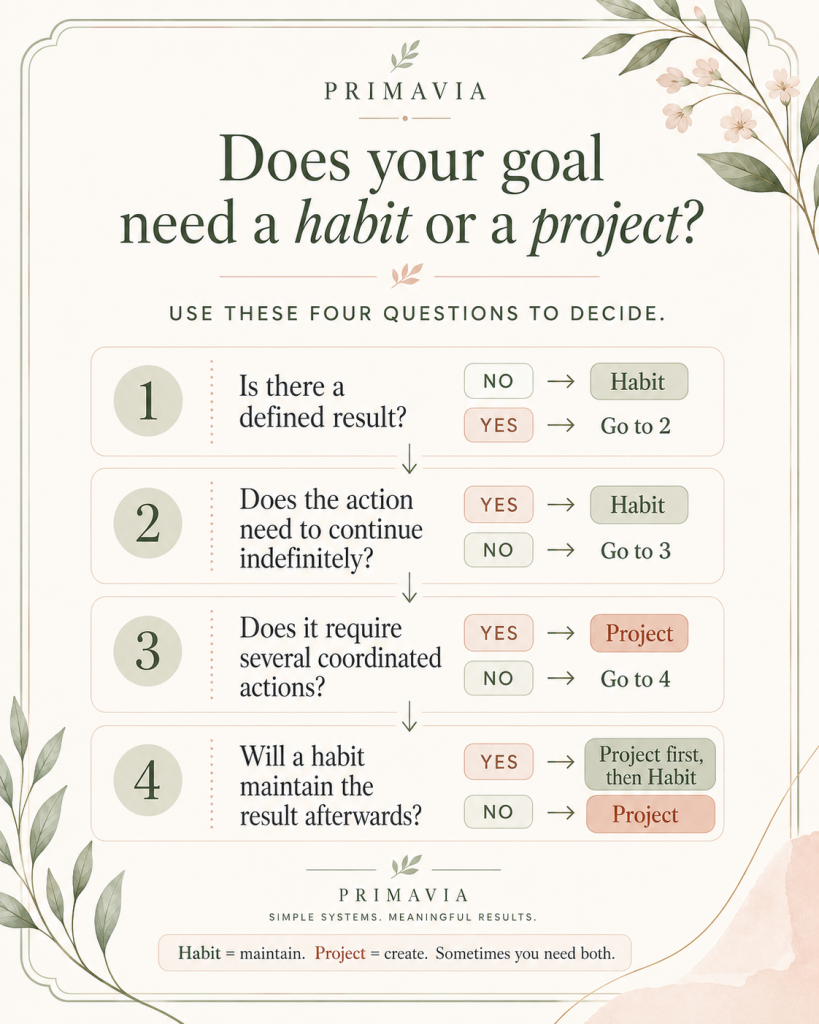
1. Is there a defined result?
“Become healthier” is broad. “Complete a 10-kilometre race in October” is a defined result that can be planned as a project.
2. Does the action need to continue indefinitely?
Daily medication, weekly planning or saving on payday may need to become habits because their value depends on repetition.
3. Does the goal require several coordinated actions?
When you need research, decisions, resources, scheduling and delivery, you are probably dealing with a project.
4. Will a habit maintain the result afterwards?
Many projects should end by identifying the small repeated actions that will stop the improvement disappearing.
Use both, but use them deliberately
You do not need to choose between being a person with good habits and a person who completes projects.
You need both.
Use projects to create meaningful change. Use habits to maintain the progress, balance and capability that matter to you.
The mistake is trying to turn every ambition into a daily routine, then blaming yourself when the routine cannot carry it.
Choose the mechanism that fits the goal.
A habit asks: What useful action should continue?
A project asks: What result am I trying to create, and what will it take to get there?